Reading the Signals in the Money Market


Interest rates often move before the effects become visible in household budgets, business plans, and investment decisions. They influence the cost of borrowing, the return on savings, the attractiveness of fixed-income investments, and the level of risk investors are willing to accept. The latest figures (June 2026) presents a market that remains expensive for borrowers, selective for savers, and uneven across different maturities.
A high-rate environment remains in place
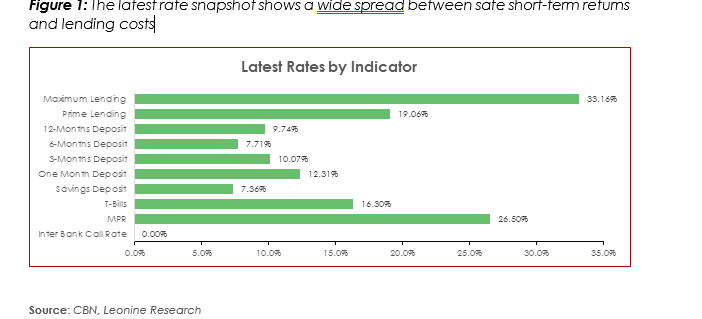
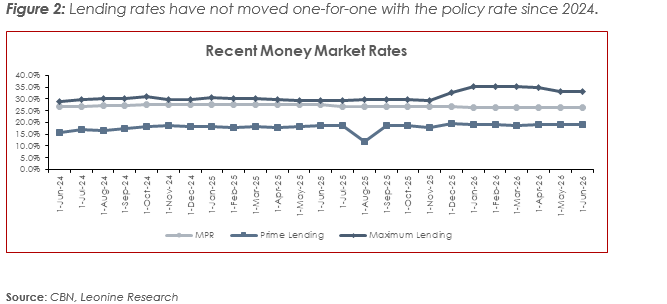
The latest data from the Central Bank of Nigeria (CBN) shows the Monetary Policy Rate (MPR) at 26.50%. This is slightly below the 27.50% recorded in 2025 and only marginally below the 26.75% recorded in 2024. This suggests that the policy environment has been broadly restrictive but relatively stable. The central question is therefore shifting from whether rates are high to how long they can remain high without weakening credit demand, investment, and economic activity.
For businesses, this stability can be helpful because it improves planning. However, stability at elevated levels still means that expansion projects, working-capital facilities, and refinancing decisions must clear a high hurdle before they become attractive.
Borrowing costs remain significantly higher than MPR
The latest Prime Lending rate (as at June 2026) is 19.06%, while the Maximum Lending rate is 33.16%. The gap between these two rates is important shows that borrowers do not face one uniform cost of credit. Stronger borrowers may access funding closer to the prime rate, while weaker borrowers or riskier transactions may face considerably higher pricing.
The Maximum Lending rate is also above the 29.31% recorded in 2025 and 28.89% recorded in 2024. This rise, despite a broadly stable policy rate, points to the importance of bank risk assessments, liquidity conditions, operating costs, and borrower quality. In practical terms, a stable policy rate does not automatically translate into cheaper credit. The transmission from policy to the real economy can be slowed by risk premiums and balance-sheet pressures.
Treasury yields suggest continued demand for liquidity
The latest Treasury-bill rate is 16.30% and this remains a substantial return for investors seeking relatively short-term instruments, although it is below the 16.99% recorded two years earlier. Treasury bills therefore continue to offer a meaningful alternative to bank deposits and riskier assets. For institutional investors, they can serve as a liquidity reserve. For businesses and households with excess cash, they provide an alternative for capital preservation while earning a return.
However, when safe short-term instruments offer attractive yields, funds may remain outside longer-term investments making it harder for private-sector projects to compete for capital, particularly when their expected returns are uncertain.
Deposit rates are uneven across maturities
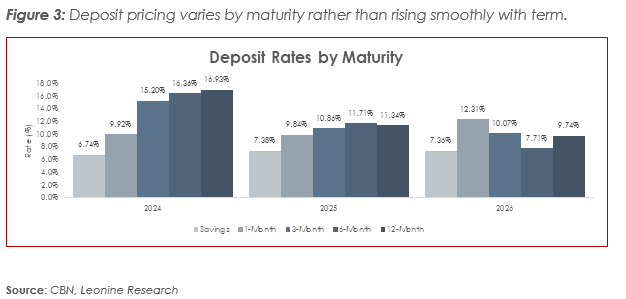
The deposit data reveal an unusual pattern as the latest Savings Deposit rate is 7.36%, while the One-Month Deposit rate is 12.31%. Beyond one month, the Three-Month Deposit rate is 10.07%, the Six-Month Deposit rate is 7.71%, and the Twelve-Month Deposit rate is 9.74%.
This is not a smooth upward curve in which longer commitments automatically receive higher returns. Instead, the one-month rate is the highest among the listed deposit products, while the six-month rate is close to the savings rate. That pattern often reflect a preference by banks and depositors for flexibility. Banks may be cautious about locking in funding for long periods, while depositors may prefer to retain access to cash in an uncertain environment.
What this means for decision-makers
For borrowers, the environment reinforces the need to manage refinancing risk, negotiate carefully, and prioritise projects with clear and relatively quick cash returns. For savers and treasury managers, the uneven deposit curve means that maturity selection matters. The highest return may not come from the longest deposit term. Comparing products across maturities is more important than relying on traditional assumptions. For investors, the combination of high policy rates, attractive treasury yields, and elevated lending costs suggests a market where liquidity and capital preservation remain central themes.
Conclusion
In line with the recent rates for money market indicators as released by CBN, this describes a money market that is stable in policy terms but demanding in practical terms. The Monetary Policy Rate remains high, the Maximum Lending rate increased compared with prior years, and deposit returns vary sharply by maturity.
The broader lesson is that headline interest rates do not tell the whole story meaning real signals are found in the spreads between policy, lending, treasury, and deposit rates. These spreads help explain how financial pressure is distributed across borrowers, savers, banks, and investors.
In such an environment, sound decisions will depend less on predicting a single rate move and more on understanding liquidity, timing, risk, and the specific pricing available to each market participant.