Nigeria’s Q1 2026 GDP: Growth Is Back, but Productivity Must Catch Up


Executive summary
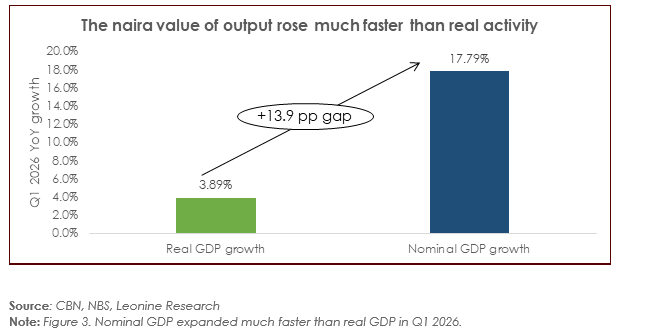
Nigeria’s economy entered 2026 with stronger momentum. Real GDP grew 3.89% year on year in Q1 2026, up from 3.13% in Q1 2025. Nominal GDP rose 17.79% to ₦110.79 trillion, which means the naira value of output increased far faster than the volume of goods and services produced. That difference is not a direct inflation measure, but it is a clear reminder that price effects remain central to the growth story.
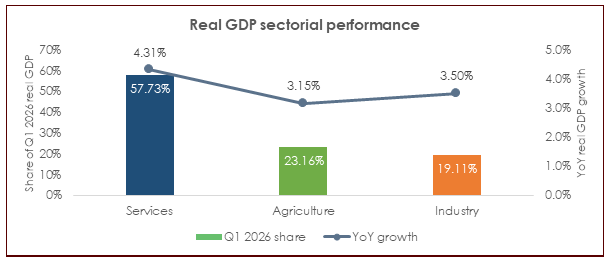
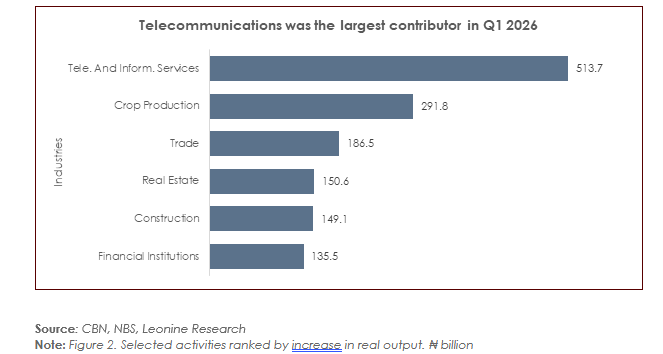
The composition of growth is encouraging but uneven. Services accounted for 57.73% of real GDP and grew 4.31%; agriculture grew 3.15%; and industry grew 3.50%. Telecommunications and information services were the largest absolute contributor, adding about ₦513.7 billion in real output. Crop production added a further ₦291.8 billion. At the same time, electricity, gas, steam and air conditioning contracted 15.30%, highlighting the infrastructure constraints that still erode economy-wide productivity.
The Q1 message is therefore two-sided meaning growth has broadened beyond oil and digital activity is becoming more important, but the operating environment has not yet improved enough for the gains to translate consistently into lower costs, stronger real incomes and better jobs.
Services are now the centre of gravity
Services generated more than half of Nigeria’s real output in Q1 2026 with 57.73% share indicating more than twice the contribution of industry, as 4.31% growth rate of the same was the strongest of the three sectors. Agriculture and industry also expanded, which matters because it makes the quarter’s improvement broader than a services-only rebound. The non-oil economy represented 96.08% of real GDP in the workbook’s calculations.
Source: CBN, NBS, Leonine Research
Note: Figure 1. Broad-sector mix and Q1 2026 real growth
Digital activity is carrying more weight
Telecommunications and information services were the clearest large-sector growth engine. Real output rose 12.24%, adding approximately ₦513.7 billion indicating the largest increase among the activities highlighted in the data. The result is significant not because telecommunications is the whole economy, but because connectivity, payments, data use and enterprise software increasingly support activity across the rest of the economy.
This shifts the policy and business question as digital scale is now visible in the national accounts. Furthermore, the next challenge will be to convert that scale into economy-wide productivity through cheaper transactions, deeper access to finance, better logistics and more reliable public and private data systems.
Agriculture is improving, but scale makes productivity essential
Crop production added about ₦291.8 billion in real output, making it the second-largest contributor among the activities shown. Its 3.39% growth rate was less dramatic than telecommunications, but agriculture’s size means even moderate gains matter for food supply, employment and rural incomes. The policy implication is straightforward: a durable improvement requires more than a cyclical rebound. Storage, transport, security, irrigation and market access must improve alongside farm output.
The nominal–real gap is the warning light
Nominal GDP growth of 17.79% exceeded real growth of 3.89% by 13.90 percentage points. The gap should not be presented as a standalone inflation rate, because GDP deflators capture economy-wide price and composition effects. It does, however, show that a large portion of the increase in naira output reflects prices rather than additional volume.
That distinction matters for decision-makers. Businesses can report higher nominal revenues while real demand grows more slowly, and households can see a stronger headline economy without an equivalent improvement in purchasing power. The quality of growth therefore depends on whether productivity rises faster than the costs of operating in the economy.
Weak spots beneath the headline
The aggregate result masks important contractions. Electricity, gas, steam and air conditioning fell 15.30%; coal mining declined 9.80%; metal ores fell 8.75%; air transport dropped 7.62%; and plastics and rubber products weakened 2.86%. The power contraction is the most consequential because unreliable or expensive energy raises costs across manufacturing, commerce and services. Weakness in transport and selected extractive activities also limits how widely the recovery can spread.
The data also come from a rebased GDP series with a 2019 base year. The rebasing expanded coverage of newer and previously under-measured activities, including digital services, pension administration, modular refineries and household employers. Comparisons across the 2020 break should therefore be treated as a mix of economic change and statistical re-benchmarking.
Bottom line
Nigeria’s Q1 2026 GDP performance is a credible return to firmer growth, led by services and reinforced by digital activity, agriculture and selected industrial segments. But it is not yet a complete development story. The decisive test is whether the current expansion can lower operating costs, lift productivity, improve real incomes and create more resilient jobs. Q1 shows that growth is back. The next task is to make it count.