Nigeria’s Pension Industry at ₦30.7 Trillion: Growth, Concentration and


Introduction
Nigeria’s pension has become a major institutional capital base, with aggregate Asset Under Management (AUM) reaching ₦30.7 trillion in June 2026. This shows strong compounding growth, rising equity exposure and a gradual reduction in the share of FGN assets, but also persistent concentration in sovereign instruments, domestic markets and the dominant Fund II cohort.

Growth of Pension Assets Under Management
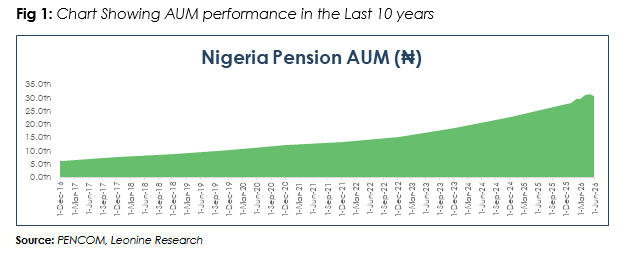
The long-term expansion is substantial as aggregate Asset Under Management (AUM) rose from ₦6.2 trillion at December 2016 to ₦30.7 trillion at June 2026 indicating an increase of approximately 398%, equivalent to roughly 18.4% compound annual growth over the period. Growth has accelerated recently particularly with AUM increasing to 20.2% between June 2024 and June 2025 and a further 24.6% year-on-year to June 2026.
This momentum reflects several interacting drivers: recurring contributions, a growing formal-sector and RSA base, investment income, market revaluation and the maturation of the Contributory Pension Scheme (CPS). Contributions were ₦1.37 trillion in 2024, up from ₦1.32 trillion in 2023 and ₦1.04 trillion in 2022. These flows provide a durable foundation, although reported AUM growth also captures changes in bond prices, equity valuations, interest rates and the naira exchange rate.
Asset Allocation Trends
The portfolio is diversifying, but from a highly conservative base. This is evident as FGN assets remained the largest category at ₦17.4 trillion, or 56.7% of AUM, in June 2026, down from 63.3% in June 2024. Equities increased to ₦6.2 trillion, or 20.2%, compared with 11.0% two years earlier. Domestic ordinary shares alone reached ₦5.9 trillion indicating a meaningful shift toward market-linked assets, but it also increases sensitivity to equity-market volatility and valuation cycles.
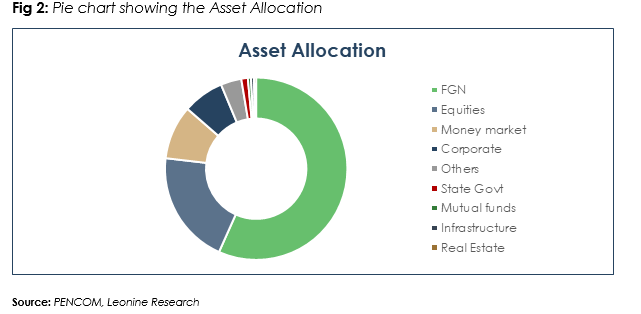
Money-market investments represented ₦2.9 trillion, or 9.6%, while corporate assets represented ₦2.2 trillion, or 7.3%. Infrastructure, private equity, real estate and mutual-fund exposures remain comparatively small. The top five individual asset classes accounted for about 85.4% of AUM, led by FGN Bonds at ₦13.6 trillion, domestic equities at ₦5.9 trillion and Local currency bank placements at ₦2.7 trillion. Foreign assets were only about ₦330 billion, or 1.1% of AUM, underscoring the industry’s strong home bias.
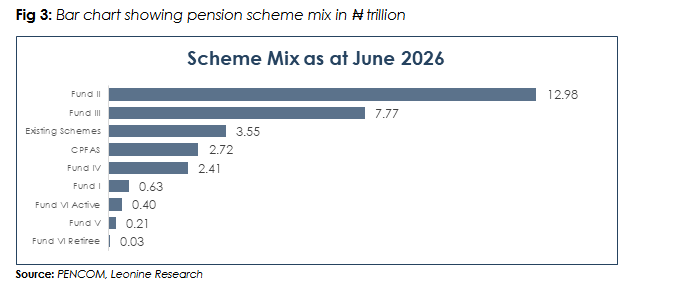
Fund II remained the centre of gravity at ₦12.9 trillion, or 42.3% of AUM, followed by Fund III at ₦7.7 trillion, or 25.3%. The lifecycle structure is valuable, but this concentration means that a large share of the AUM investment outcomes is tied to one member cohort and its risk profile.
Key Insights and Industry Implications
Three implications stand out. First, sovereign concentration remains the principal portfolio risk. High inflation, elevated interest rates and government borrowing can support attractive nominal yields, but they also increase duration, reinvestment and fiscal-credit sensitivity.
Second, the rise in equities is positive for long-term real returns and capital-market development, yet it requires stronger governance, valuation discipline and liquidity management.
Third, the 98.9% local allocation creates both economic impact and macroeconomic concentration: pension assets benefit Nigeria, but are simultaneously exposed to domestic inflation, currency weakness and policy shocks.
For PFAs, the priority is to strengthen asset-liability management, lifecycle differentiation, stress testing and manager selection. Custodians and regulators must reinforce valuation transparency, liquidity controls and risk reporting. For policymakers, a deeper pipeline of investable infrastructure and corporate instruments is as important as changes to allocation limits.
Emerging Opportunities and Outlook
The opportunity is to convert scale into productive diversification which is indicative of the fact that Infrastructure financing can expand through well-structured project bonds, credit-enhanced vehicles and transparent public-private partnerships. Private equity and private credit can improve long-term return potential, provided governance, exit routes and independent valuation are credible. Green bonds, climate-resilient infrastructure and sustainable-investment frameworks can align pension capital with Nigeria’s financing needs while improving portfolio breadth.
Further growth will depend on consistent contributions, better coverage of the informal economy, reliable data and reforms that deepen domestic capital markets. International diversification, where permitted, should be viewed as prudent risk management rather than a retreat from domestic development.
Conclusion
Nigeria’s pension industry has achieved impressive scale and remains on a strong growth path as Leonine Research analysis confirms an industry that is moving gradually from sovereign-heavy portfolios toward greater equity participation, while still retaining substantial concentration in FGN instruments, domestic assets and Fund II. Stakeholders should now focus on building investable supply, improving diversification, managing inflation and currency risk, and ensuring that lifecycle funds deliver outcomes appropriate to members’ horizons. If these priorities are addressed, the CPS can become not only a larger savings system, but a more resilient retirement platform and a more powerful source of long-term Nigerian capital.