Nigeria Share Market Insight: 2019–2026


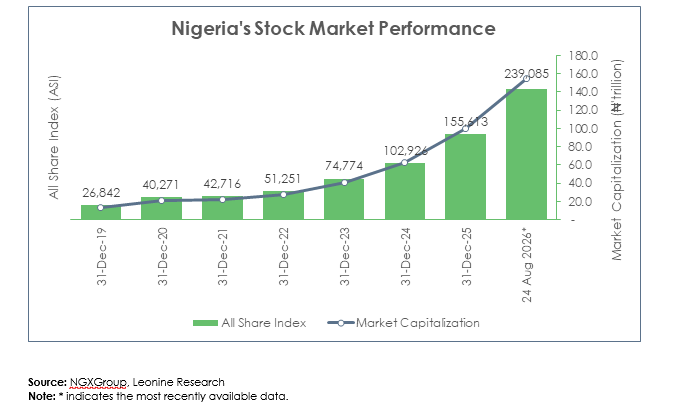
Nigeria’s capital market data show a decisive multi-year re-rating of Nigeria’s equities market. The NGX All-Share Index rose from 26,842.07 points at the end of 2019 to 239,085.17 points by 24 August 2026, while equity market capitalisation expanded from ₦12.97 trillion to ₦154.40 trillion over the same period. This reflects a market that has moved from post-2019 recovery into a sustained bull cycle, with the strongest acceleration occurring between 2023 and 2026.
Performance trajectory
The performance trajectory shows consistent year-on-year gains after 2019. The ASI advanced by 50.03% in 2020, followed by a more modest 6.07% rise in 2021 and a stronger 19.98% gain in 2022. Momentum accelerated materially from 2023, with the index rising 45.90% in 2023, 37.65% in 2024, and 51.19% in 2025. By 24 August 2026, the ASI had gained a further 53.64% year-to-date, reaching 239,085.17 points. Market capitalisation followed the same pattern, increasing from ₦12.97 trillion in 2019 to ₦154.40 trillion by August 2026, with annual gains of 62.37% in 2020, 5.89% in 2021, 25.20% in 2022, 46.58% in 2023, 53.39% in 2024, 58.34% in 2025, and 55.37% year-to-date in 2026.
- Inflation hedge: Persistent inflation increased demand for equities with strong pricing power, especially in banking, industrials, consumer goods, oil and gas, and high-dividend names.
- Liquidity rotation: Periods of negative real fixed-income returns encouraged domestic institutional and retail investors to rotate into equities.
- Earnings resilience: Large-cap companies delivered stronger nominal earnings, partly reflecting price increases, foreign-exchange gains, and balance-sheet expansion.
- Banking sector catalyst: Expectations around banking recapitalisation and stronger balance sheets supported renewed interest in tier-one banks.
- Limited foreign participation: The rally has been heavily domestic-led, reducing dependence on foreign portfolio flows but also increasing sensitivity to local interest-rate conditions.
What the 2019–2026 trend suggests
The 2019–2026 trend suggests that Nigerian equities increasingly served as a vehicle for capital growth and inflation protection. Between 31 December 2019 and 24 August 2026, the ASI expanded by roughly 790.7%, while equity market capitalisation increased by about 1,090.4%. The faster rise in market capitalisation indicates that the rally was not only index-price driven; it also reflected a broader expansion in market value, supported by stronger valuations, new listings or capital actions, and deeper domestic participation.
Investor implication and outlook
Looking ahead, the 24 August 2026 data point to a market with exceptional momentum, but also one where valuation discipline is increasingly important. After annual ASI gains of 45.90% in 2023, 37.65% in 2024, 51.19% in 2025, and 53.64% year-to-date in 2026, investors should expect periodic profit-taking and greater volatility. The market remains attractive, but the risk-reward balance is likely to favour companies with visible earnings growth, durable margins, strong cash flows, and sustainable dividend capacity.