Aligning Business Planning with Value Maximization Strategies


For founders and investors, business planning should not be a static document prepared only for fundraising, board meetings, or lender discussions. It should function as a practical value-creation document such that it helps decide where the business is going, how resources will be deployed, what risks must be managed, and how every major decision improves enterprise value. When a business plan is aligned with value maximization, it becomes more than a narrative; it becomes a tool for winning investor confidence, attracting strategic partners, and signing on new mandates and projects.
Start with Value, Not Activity
Many businesses confuse activity with progress. They build products, expand teams, enter markets, and pursue revenue without clearly defining how those activities increase value. A value-focused plan begins with a simple question; what makes this business more valuable over time? The answer may include sustainable cash flows, strong margins, recurring revenue, customer retention, defensible market position, capital efficiency, or credible exit options.
For founders, this means planning around the drivers that investors and acquirers actually price. For investors, it means evaluating whether management’s strategy can convert opportunity into measurable returns. A business plan that does not explain how value will be created, protected, and realized is incomplete.
Use an Investor-Ready Value Map
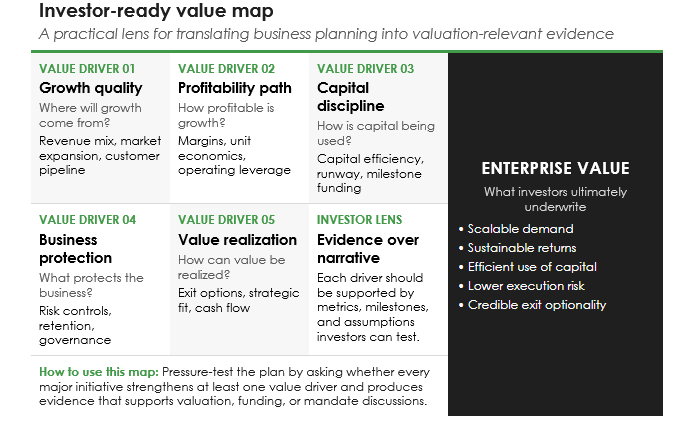
The value map below sets out the five drivers that carry valuation weight. The sections that follow work through each of them in turn.
Translate Strategy into Measurable Value Drivers
Strong business planning links strategic objectives to measurable value drivers. If the goal is growth, the plan must explain whether growth will come from new customers, higher pricing, cross-selling, geographic expansion, partnerships, or product innovation. If the goal is profitability, it must identify the levers such as gross margin improvement, operating efficiency, procurement discipline, automation, or better working capital management.
The most useful plans connect ambition to evidence. They include market size, customer segments, pricing logic, unit economics, funding needs, milestone timelines, and risk assumptions. This makes the plan easier to test, easier to finance, and easier to execute.
Build the Plan Around Capital Allocation
Value maximization depends heavily on how capital is allocated. Every naira, dollar, or equity stake committed to an initiative should have a clear purpose and expected return. A founder’s plan should therefore show why funds are being raised, what milestones the capital will unlock, how much runway it creates, and how success will be measured. Investors, in turn, should assess whether each use of capital increases the probability of a stronger valuation, lower risk, or more attractive exit. \ \ This discipline is especially important where capital is selective. A plan that shows capital efficiency can reduce dilution, strengthen negotiating power, and create confidence that management understands the trade-off between speed and sustainability.
Protect and Realize the Value Created
Growth, margin and capital discipline build value in terms of risk controls and exit readiness are what preserve and convert it. A credible plan therefore explains what protects the business with respect to customer concentration limits, contract quality, key-person dependency, regulatory exposure, retention of both customers and staff, and the governance controls that keep management honest about performance. Investors discount for execution risk, so evidence of control is directly valuation relevant.
The plan should also be explicit about realization. Value that cannot be accessed is value investors will not fully price. That means setting out plausible routes to liquidity trade sale, sponsor exit, recapitalization, or sustained distributable cash flow and identifying which strategic acquirers or capital partners the business is being positioned for. Naming the eventual buyer of the story disciplines the choices made today.
Embed Governance and Accountability
Plans create value only when they are monitored. Founders should define ownership, timelines, reporting cadence, and decision rights for each strategic initiative. Investors should insist on dashboards that track revenue quality, cash conversion, customer retention, burn rate, return on invested capital, and milestone delivery. This turns the business plan into a living management system rather than a one-off document.
Conclusion
Aligning business planning with value maximization requires discipline, clarity, and evidence. The best plans do not simply describe what a company hopes to achieve; they show how growth, profitability, capital allocation, risk management, and governance work together to increase enterprise value. For founders, this alignment strengthens credibility and execution. For investors, it improves decision-making and return visibility. For advisors, it creates a sharper platform for securing mandates and projects by helping clients move from ambition to measurable value creation.